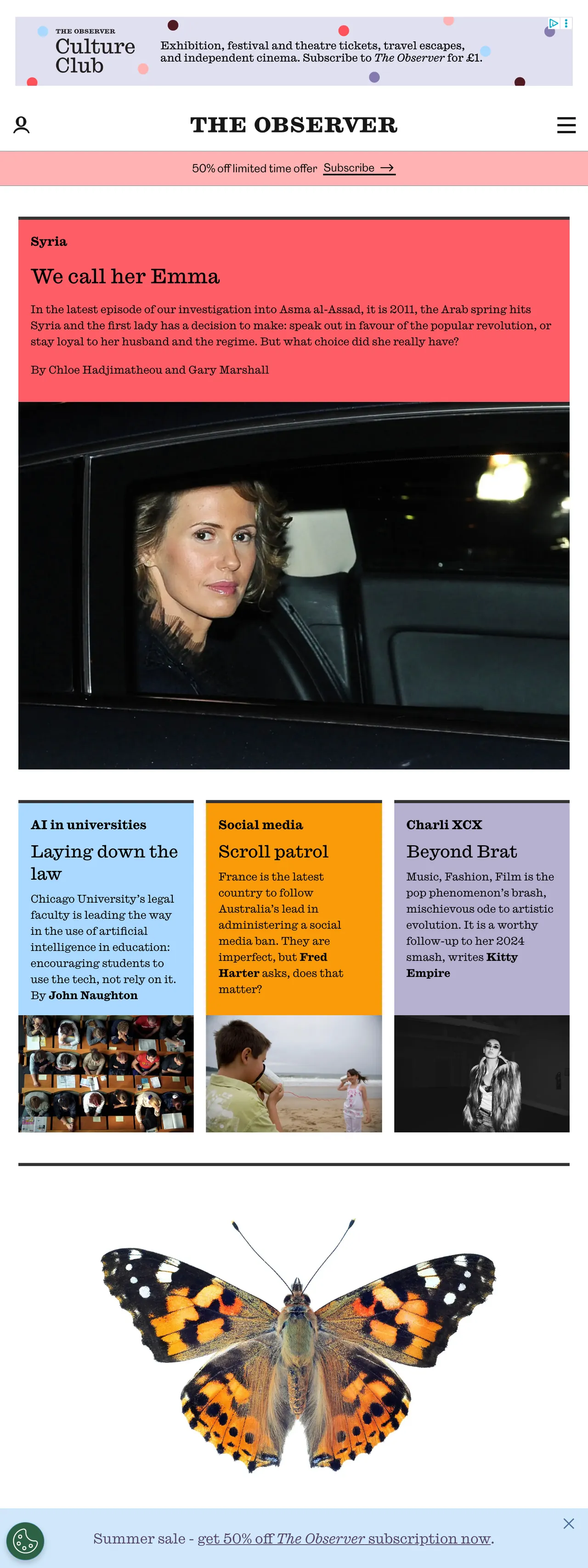
We Call Her Emma: Asma al-Assad's Dilemma in 2011 Syria ↗
Front page leadAn investigation into Asma al-Assad's decision during the 2011 Arab spring in Syria: whether to support the popular revolution or remain loyal to her husband and the regime.

What's happening in Europe?
 United Kingdom
The Observer's front page features a mix of international and domestic news, with a prominent story on Syria's first lady, Asma al-Assad. Other key articles cover AI in universities, social media bans, the music of Charli XCX, and a report on painted lady butterflies in the UK. There are also…
An investigation into Asma al-Assad's decision during the 2011 Arab spring in Syria: whether to support the popular revolution or remain loyal to her husband and the regime.
Chicago University's legal faculty is pioneering the use of artificial intelligence in education, encouraging students to utilize the technology rather than solely rely on it.
Following Australia's lead, France is implementing social media bans; this article questions whether their imperfections diminish their overall effectiveness.
The article explores Charli XCX's 'Beyond Brat', a pop phenomenon described as a brash and mischievous ode to artistic evolution, serving as a follow-up to her previous hit.
The United Kingdom is a key location for the migration of painted lady butterflies, and this year is predicted to be a particularly abundant one.
An article by Isabel Coles addressing the issues surrounding the Western Sahara, described as amounting to plunder.
Imran Shafi discusses how Andy Burnham can position Britain at the forefront of the AI revolution, exploring strategies for the nation's future.
David Williams explores Albariño and Vermentino, highlighting them as two emerging stars in the world of white wines.
Barbara Ellen examines the presence and impact of Boris Johnson's influence in Ukraine, referring to it as the 'Johnson effect'.
Forensic archaeologist Dr Karl Harrison and fashion historian Amber Butchart analyze swaddling garments to uncover the secrets behind the discovery of a dead infant hidden in a cupboard.
Film review by Wendy Ide of 'Ask E. Jean', described as an understated portrait of a woman who confronted Donald Trump.
Sarah Crompton reviews Mamela Nyamza's work at the Biennale, focusing on her balancing acts.
Fiona Maddocks provides a guide to the upcoming Proms, covering performances from Carol Ann Duffy's poems to Mahler's First, performed by heart.
Laura Cumming delves into the art and life of Richard Dadd, exploring his fantastical and troubled world.
Adele Zeynep Walton argues that online curfews are a PR stunt and that internet platforms, not users, require regulation.
Kate Maltby contends that attacks on net zero policies and ECHR supporters by figures like Badenoch will not appeal to undecided voters.
John Naughton explores how social media, despite promising connection, ultimately leads to isolation by causing context to collapse.
Ben Zaranko presents arguments in favour of increasing taxes on older demographics.
An investigation into the donors supporting Reform UK, examining the financial backing and relationship with its major contributors, and what this implies for a potential government.
Catherine Neilan reports on a Reform UK donor who incurred significant financial losses through bets related to Iran and Keir Starmer.
Ceri Thomas discusses how Nigel Farage could potentially profit millions by publicly endorsing Bitcoin shares.