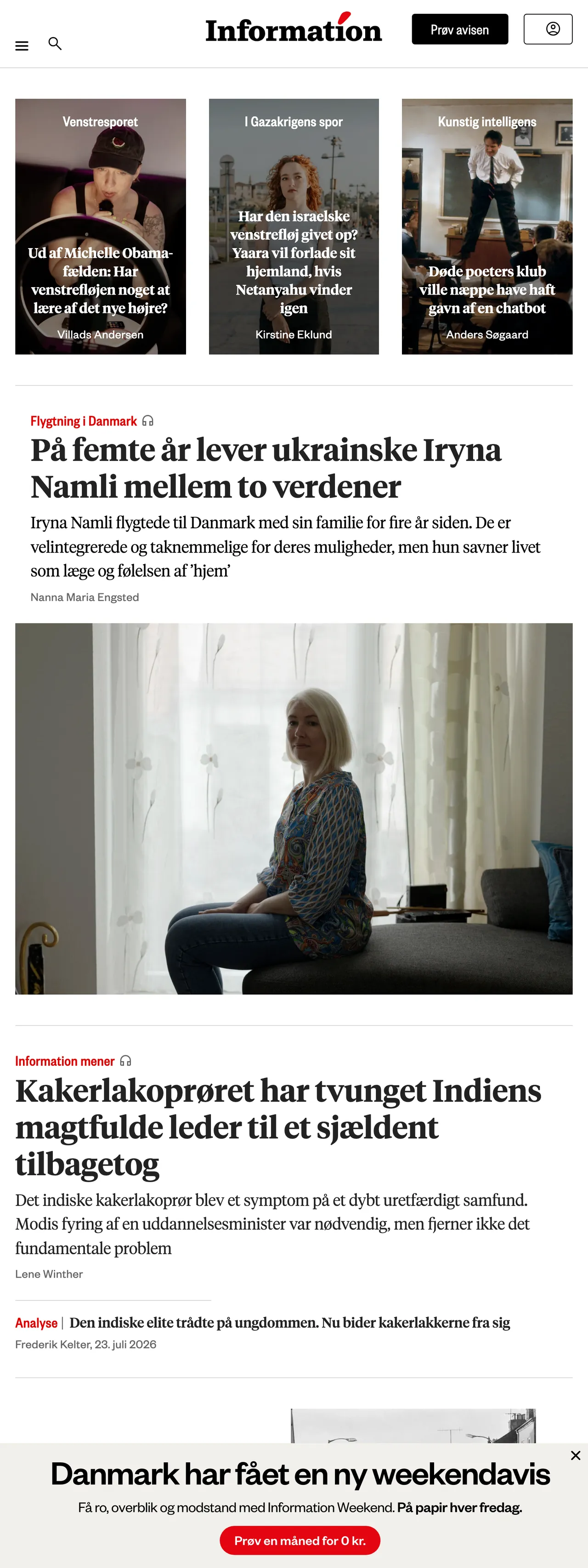
Out of the Michelle Obama Trap: Can the Left Learn from the New Right? ↗
Front page leadThis article questions whether the political left can learn valuable lessons from the strategies and approaches of the emerging right-wing political movements.

What's happening in Europe?
 Denmark
The front page of Information, a Danish newspaper, features a mix of domestic and international news. Key stories include an analysis of the left-wing's potential to learn from the new right, the ongoing impact of the Gaza war on the Israeli left, and a look at the role of artificial intelligence…
This article questions whether the political left can learn valuable lessons from the strategies and approaches of the emerging right-wing political movements.
The story explores the potential emigration of an Israeli leftist individual if Benjamin Netanyahu secures another victory, reflecting on the state of the left in Israel amidst the Gaza war.
This piece delves into the impact of artificial intelligence, specifically chatbots, on creative fields and literature, suggesting limited benefits for artistic endeavors.
The article focuses on Iryna Namli, a Ukrainian refugee who has lived in Denmark for four years. While integrated and grateful, she misses her former life as a doctor and her sense of home.
An editorial discussing the recent protests in India, sparked by an exam scandal, as a symptom of societal injustice and a rare instance of a rollback by the Modi government.
This analysis examines the widespread youth protests in India, where young people self-identify as 'cockroaches' demanding justice after an exam scandal, potentially forming a new political force.
This commentary argues against selectively extracting ideas from the philosopher Martin Heidegger, suggesting a more holistic engagement with his work is necessary.
A book review reflecting on contemporary society's relationship with luck and chance, suggesting a societal over-reliance on perceived certainties while neglecting the role of serendipity.
This article explores Danish identity through the personal experience of Mia May, who felt compelled to suppress her Israeli and Jewish background to be accepted as Danish after the October 7th attack.
This piece examines the pressure on individuals with immigrant backgrounds to constantly prove their Danish identity, as expressed by a parent hoping for a different future for their children.
Twana Ismaeil shares her experience of constantly having to prove her Danishness, highlighting the challenges faced by refugees in gaining recognition and being heard in Danish society.
This article likely discusses the perspectives of the far-right in Denmark regarding national identity and immigration, possibly in relation to the broader theme of 'Am I Danish?'.