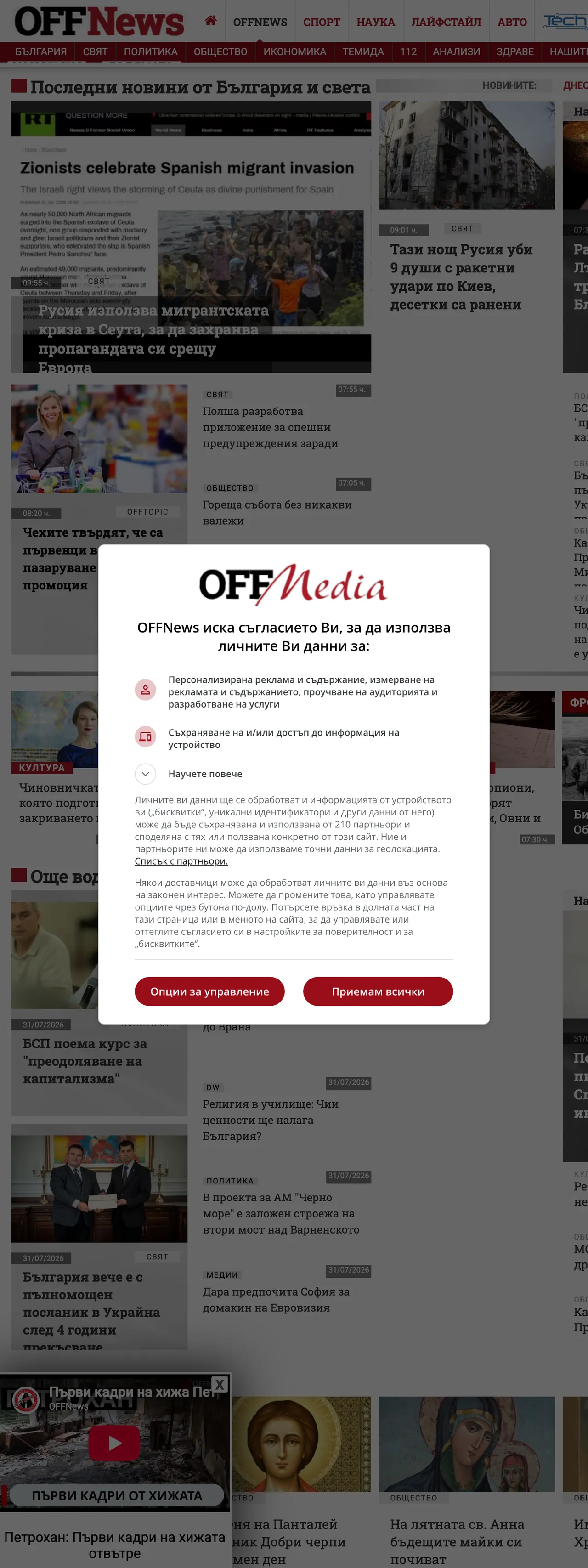
Russia uses Ceuta migrant crisis to fuel anti-Europe propaganda ↗
Front page leadRussia is reportedly exploiting the migrant crisis in Ceuta to amplify its propaganda efforts against Europe, as thousands of migrants cross the border.

What's happening in Europe?
 Bulgaria
The OFFNews front page features a mix of international and domestic news. Key international stories include Russia's alleged use of the migrant crisis in Ceuta for propaganda, missile attacks on Kyiv, and Poland developing an early warning app due to Russian actions. Domestic news covers the…
Russia is reportedly exploiting the migrant crisis in Ceuta to amplify its propaganda efforts against Europe, as thousands of migrants cross the border.
Overnight missile attacks by Russia on Kyiv have resulted in the deaths of nine people and injured dozens more, highlighting the ongoing conflict.
A report suggests that Czech consumers are leading the European Union in purchasing discounted goods during promotions.
In response to a Russian missile incident, Poland is developing a new application to provide urgent public warnings.
The weather forecast for Saturday indicates hot temperatures with no rain expected across the region.
Italy has temporarily suspended the Schengen agreement with Spain in response to the ongoing crisis in Ceuta.
The Bulgarian Socialist Party (BSP) has announced a new political direction aimed at challenging and overcoming capitalism.
After a four-year hiatus, Bulgaria has appointed a fully-fledged ambassador to Ukraine, strengthening diplomatic ties.
The controversial case of Father Nikanor has led to protests, synodal disciplinary action, and a legal battle concerning Bulgarian Orthodox Church finances.
A high-ranking official responsible for the planned closure of the Czech Center in Sofia has been dismissed following a scandal.
An updated report indicates that approximately 48,000 migrants have voluntarily returned from Ceuta to Morocco.
The first of eight anticipated American military aircraft has successfully landed at the Bezmer airbase.
A film by Kamen Nevenkin explores the significance of the Battle of Kursk as a pivotal moment in World War II.