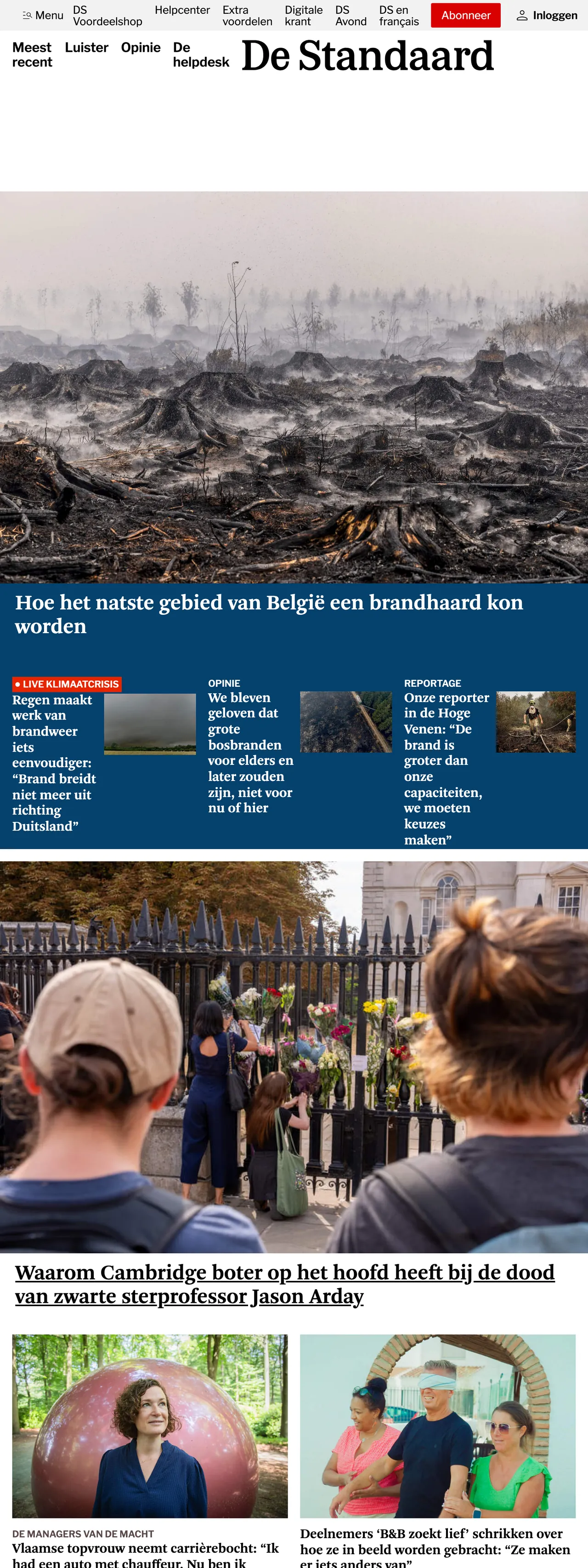
How Belgium's Wettest Area Became an Inferno ↗
Front page leadVast peatlands and immense carbon stores are being destroyed by fires in the High Fens, caused by exceptional drought and centuries of drainage for forestry.

What's happening in Europe?
 Belgium
The De Standaard front page highlights the severe wildfires in Belgium's High Fens region, emphasizing the devastating impact of drought and historical land management practices. The coverage includes live updates, opinion pieces reflecting on the disaster, and a reporter's on-the-ground account…
Vast peatlands and immense carbon stores are being destroyed by fires in the High Fens, caused by exceptional drought and centuries of drainage for forestry.
Rain is making the work of firefighters slightly easier as the fire in the High Fens is no longer spreading towards Germany, amidst global climate change impacts.
Five years after Belgium's greatest natural disaster, David Van Reybrouck laments the largest forest fire on record, reflecting on a past belief that such events were not possible locally.
The fire in the High Fens rages uncontrollably, with firefighters struggling to contain it and facing difficult choices as the landscape turns black and smoldering.
The death of Cambridge professor Jason Arday is analyzed as a Greek tragedy, where inflated heroism led to his downfall after the university ignored warnings, contributing to a 'lynching'.
Julie Bynens, former Secretary-General of the Chancellery and Foreign Affairs department, discusses her career shift and redefining her identity away from her high-profile role.
Participants in the VTM reality show 'B&B zoekt lief' are surprised by how they are depicted, with editing creating comedic or misleading scenes, which the production company attributes to the nature of TV making.
The Federal Agency for the Safety of the Food Chain (FAVV) closed over 500 businesses in 2025, a record, but experts suggest this doesn't indicate a decline in food safety.
Belgium's employment rate is rising slowly, with the target of 80 percent not expected to be reached by 2031, partly due to the expansion of flexi-jobs.