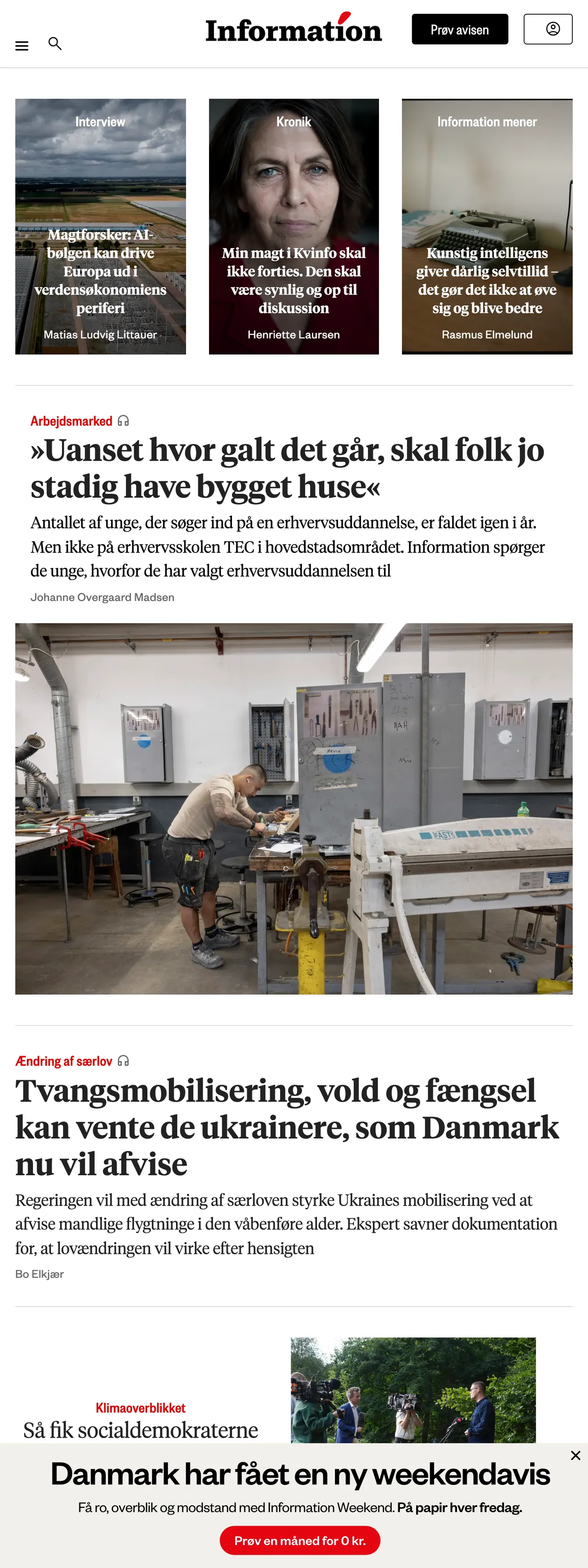
Power researcher: AI wave could push Europe to the periphery of the world… ↗
A power researcher suggests that the current wave of artificial intelligence development could lead to Europe becoming marginalized in the global economy.

What's happening in Europe?
 Denmark
The front page of Information features a mix of domestic and international news, with a strong focus on technology's impact on society and the economy, labor market issues, and geopolitical analysis concerning Ukraine and the Korean peninsula. There's also a prominent story about the declining…
A power researcher suggests that the current wave of artificial intelligence development could lead to Europe becoming marginalized in the global economy.
Henriette Laursen argues that her influence within Kvinfo should be transparent and subject to public debate.
An editorial piece suggests that artificial intelligence negatively impacts self-esteem, while the act of practicing and improving leads to better confidence.
Despite a national decline in vocational education enrollment, Denmark's TEC vocational school is seeing increased interest. The article explores why young people are choosing these trades.
The Danish government plans to change a special law to strengthen Ukraine's mobilization by rejecting male refugees of draft age. An expert questions the effectiveness of this measure.
This article from 'Klimaoverblikket' discusses the Social Democrats' stance on wolf conservation.
An analysis of Donald Trump's foreign policy decisions concerning the Korean Peninsula, suggesting a prioritization of adversaries over allies.
This piece delves into philosopher Heidegger's views on technology and its tendency to instrumentalize everything, set against the backdrop of modern crises like climate change and AI.
The article discusses the presence of wolves in Denmark, exploring the biological capacity for more wolves and the societal challenges this presents.
An editorial reflecting on an incident involving a wolf near Nørre Nebel, suggesting that the presence of wolves continues to be a contentious issue in Denmark.
This article investigates whether the working conditions and model of Wolt couriers pose a threat to the established Danish labor model, based on an interview with a courier.
The Danish labor union 3F is prepared to pursue legal action to compel Wolt to enter into a collective bargaining agreement for its food delivery couriers.
The legal status of Wolt couriers in Denmark is contested, with tax authorities viewing them as employees while the company maintains they are self-employed. The Eastern High Court will make a ruling.
A Wolt courier shares his experience of declining pay over five years with the company, despite initially seeking more freedom.