Jimmie Åkesson aims to surpass the Danish People's Party ↗
Front page leadAn analysis piece discussing Jimmie Åkesson's political strategy and his party's goals, aiming to exceed the influence of the Danish People's Party.

What's happening in Europe?
 Denmark
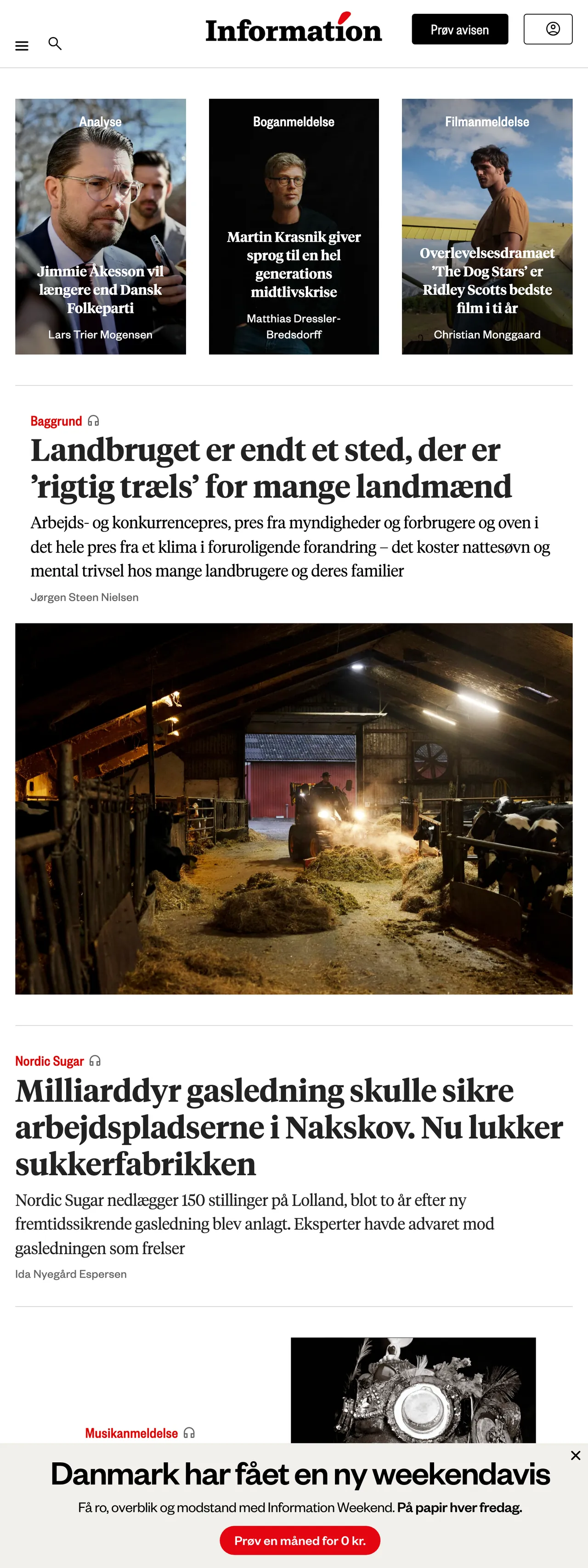
The front page of Information, a Danish newspaper, features a mix of domestic and cultural news. Prominent stories include an analysis of Jimmie Åkesson's political ambitions, a book review of Martin Krasnik's work, and a film review of Ridley Scott's 'The Dog Stars'. Domestic issues are covered…
An analysis piece discussing Jimmie Åkesson's political strategy and his party's goals, aiming to exceed the influence of the Danish People's Party.
A book review that explores Martin Krasnik's work, which is described as capturing the midlife crisis of an entire generation.
A film review praising 'The Dog Stars' as Ridley Scott's best cinematic achievement in the past ten years, categorizing it as a survival drama.
A background report detailing the pressures faced by the agricultural sector in Denmark, including economic, regulatory, and climate-related challenges, leading to mental distress for farmers.
Report on Nordic Sugar closing 150 jobs in Nakskov, Denmark, two years after a costly gas pipeline was built, despite expert warnings against it being a solution.
A music review discussing the legacy of a 'mad dub professor' and their significant contribution to music.
A background article aiming to explain the details and context of a past 'statehood case'.
An opinion piece arguing that forgiveness is essential to move past the issues raised by the MeToo movement.
An archival essay celebrating Dolly Parton's impact on country music and the women's movement, highlighting her role as a master of forgiveness.
A chronicle arguing that religious covering does not require feminist validation to be considered a free choice for women.
A reader's letter expressing disagreement with the idea that women should cover themselves, referencing the feminist struggles of the 1970s.
Isam Bachiri's chronicle arguing that a niqab can be considered feminist if it is a personal choice made by the woman wearing it.
A reader's letter criticizing the notion that women choose to wear the niqab freely, suggesting that power structures and social control are often influential.
A reader's letter asserting that the interpretation of wearing a niqab belongs to the individual woman and should not be dictated by 1970s feminist perspectives.