Front page lead
A security expert suggests that internal reports may have indicated to Putin that Russia's ability to continue the war is diminishing, implying internal dissent or realistic assessments within the Kremlin.
An opinion piece by a security expert argues that the Kremlin's response to drone attacks within Russia will negatively impact businesses as they will bear the brunt of the cost for security measures.
A columnist reflects on the persistent nature of communist ideology and its lingering influence, suggesting it has not truly died despite the collapse of the Soviet Union.
A former US diplomat states that any significant Russian aggression against the Baltic states would elicit a swift and decisive response from NATO, without prolonged deliberation.
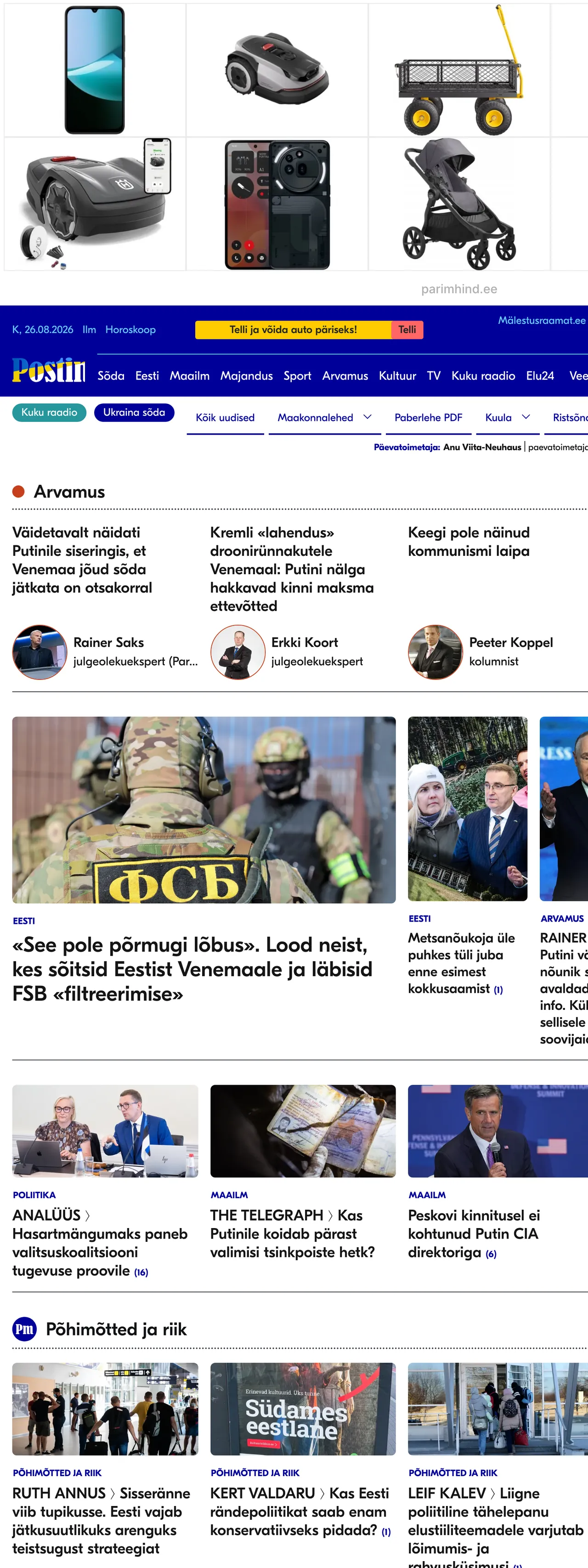
This story recounts the experiences of individuals who traveled from Estonia to Russia and were subjected to 'filtration' processes by the FSB, detailing the difficult and unpleasant nature of these encounters.
A conflict has arisen concerning the Estonian Forestry Chamber even before its initial meeting, indicating potential disagreements over its formation or purpose.
An analysis by Rainer Saks suggests that a less prominent advisor to Putin may have released significant information, questioning who would be interested in such details.
Hyundai has released an affordable electric car in the European market that is not slated for release in the US, leaving American consumers without access to this budget-friendly option.
An analysis discusses how the introduction of a gambling tax is likely to create friction and test the unity and stability of the current Estonian government coalition.
A report from The Telegraph speculates on whether Putin may face a reckoning or a 'zinc boys' moment (referring to soldiers lost in conflict) following upcoming elections.
Kremlin spokesperson Dmitry Peskov has officially stated that Russian President Vladimir Putin did not have a meeting with the Director of the CIA.
This health-related article explores a surprising connection, investigating why indications of heart attack risk in women are frequently identified during visits to a gynecologist.
Ruth Annus argues that Estonia requires strong public trust and confidence to effectively implement and sustain its strategic development plans.
Kert Valdaru examines whether Estonia's current migration policies lean towards a more conservative approach, analyzing key aspects of the policy.
Leif Kalev suggests that insufficient political focus on electoral processes is leading to skewed or inaccurate outcomes in elections.

 Estonia