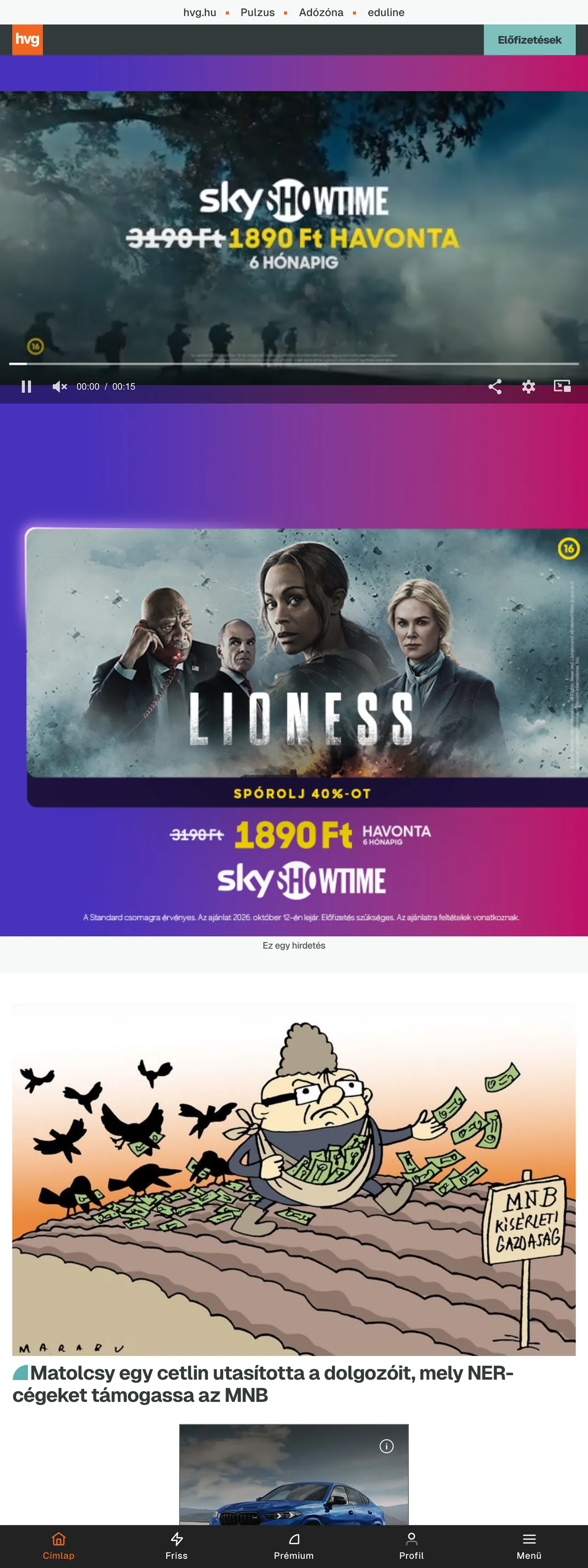
Front page lead
An article details how the governor of the National Bank of Hungary, Matolcsy, allegedly used a handwritten note to direct staff to support specific companies linked to the ruling Fidesz party (NER) with funds from the MNB, hinting at potential misuse of funds.
Political commentator Tóta W. Árpád analyzes Viktor Orbán's vision upon his potential return to a prime ministerial role, suggesting that Orbán has defined what Fidesz represents, implying that this vision is ultimately ineffective.
An expert from the National Public Health Center is interviewed about the critical importance of hygiene, such as handwashing, in preventing dangerous infections within hospitals, particularly in the context of the year 2026.
A leaked report or information suggests a significant internal conflict within the Tisza Party, describing an incident as a 'life-threatening action,' indicating deep divisions within the political movement.
Magyar Péter, a prominent figure in the Tisza Party, addressed a reported internal conflict, stating that trust in the community members currently involved remains strong and unbroken.
David Vitézy has publicly reacted after Prime Minister Viktor Orbán characterized him as an agent or representative of German interests, addressing the politically charged statement.
Prime Minister Viktor Orbán issued threats on HírTV directed at individuals considering employment at the newly established Hungarian asset recovery office, implying repercussions for such positions.
Physicist and author Carlo Rovelli discusses the current global trajectory, likening it to sleepwalking towards disaster, and explores themes of responsibility and the potential for a world government to achieve peace.
In an interview, Magyar Péter stated his political plans, indicating that Hungary will see a new electoral law and a new constitution implemented by the year 2030.
Education researcher Radó Péter observes that the start of the academic year reflects the ongoing implementation of the centralized education system characteristic of the 'NER' (National Cooperation System) in Hungary.
Molnár Áron claims that forbidden campaign financing activities may have taken place in the Zugló district, involving National Cultural Fund (NKA) money allocated to Radics Béla.
The results of the Swedish parliamentary elections are very tight, with the opposition bloc holding a slim lead as the vote count continues.
An American expert on Russia, Michael David Fox, suggests that Western assessments of Vladimir Putin's capabilities and influence are significantly exaggerated.
Economist Zoltán Pogátsa begins a new podcast series, 'Economic Entrance,' questioning the perceived importance and role of the Euro in the economy.
Despite growing concerns about artificial intelligence, former President Donald Trump has stated that there is no necessity for regulating AI development.
Prince Harry and Meghan Markle are reportedly considering legal action against a status or role assigned to them by the King, indicating a further rift within the royal family.
The article discusses the trend of girls experiencing their first menstruation at younger ages and explores whether parents should consider interventions to delay this biological process.
A test drive review of the new Skoda Epiq electric car, highlighted as the cheapest and smallest electric model, conducted in Tyrol.
This news piece introduces the new Audi A2 in Hungary, noting its position as the smallest and most affordable electric car from the brand available in the country.
Volkswagen's new electric car, part of the 'Mission Efficiency' initiative, is presented as a groundbreaking model in terms of energy consumption.

 Hungary