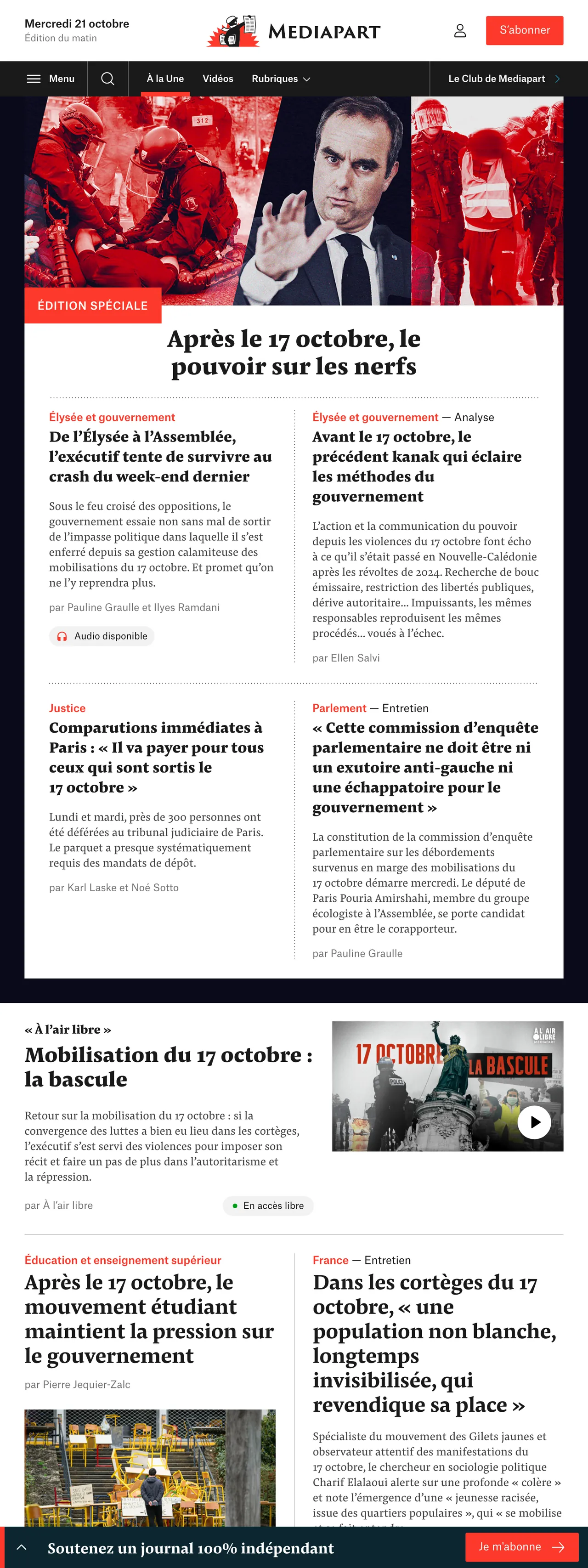
Front page lead
Following protests on October 17, the French executive is attempting to survive a political crisis amidst opposition pressure and promises to avoid repeating past mistakes in managing public demonstrations.
The government's actions and communication since the October 17th violence echo events in New Caledonia after revolts in 2024, involving scapegoating, restricting freedoms, and authoritarian drift, all likely to fail.
Nearly 300 people were brought before the Paris judicial court on Monday and Tuesday, with prosecutors systematically requesting pre-trial detention.
The formation of a parliamentary inquiry commission into the disturbances during the October 17 mobilizations begins Wednesday, with Paris deputy Pouria Amirshahi seeking to co-rapport.
Reflecting on the October 17 mobilization, the article suggests that while struggles converged in the marches, the executive used the violence to impose its narrative and advance authoritarianism and repression.
The student movement continues to exert pressure on the government following the October 17 events.
A political sociology researcher highlights deep anger and the emergence of a "racized youth from working-class neighborhoods" mobilizing and making their voices heard during the October 17 demonstrations.
High school students explain how platforms like TikTok and Instagram have amplified their anger into a movement that can no longer be ignored, amidst government discussions of social media restrictions.
MEP Rima Hassan is on trial, with her lawyer protesting the prosecution's actions as a political disqualification.

 France