Front page lead
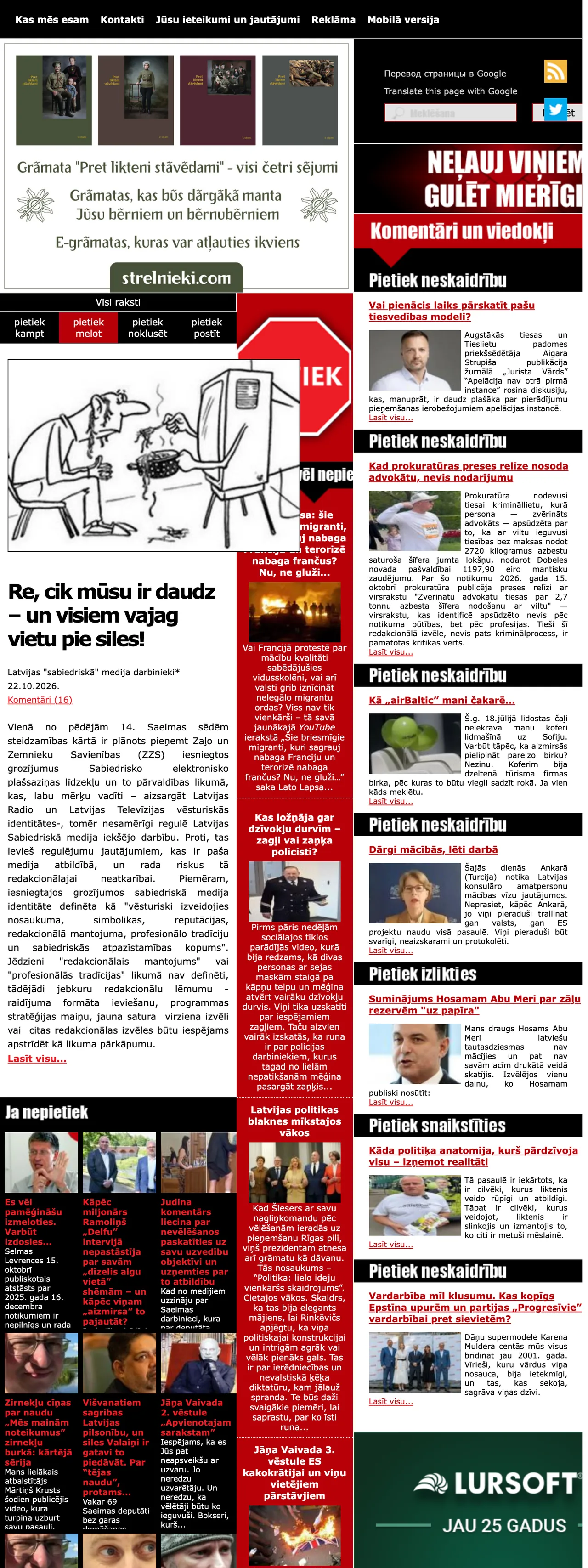
Proposed amendments to the Law on Public Electronic Mass Media, submitted by the Union of Greens and Farmers, are set to be adopted urgently. While aiming to protect the historical identity of Latvian Radio and Television, these amendments are criticized for excessively regulating the internal…
An article questions why millionaire Andris Ramoliņš did not disclose his 'diesel for salary' schemes in a Delfi interview and why he was not asked about them.
A commentary by Judina is seen as indicative of an unwillingness to objectively assess one's behavior and accept responsibility, particularly in relation to a Saeima employee involved with an MP.
This article discusses the ongoing conflicts and power struggles within a group, symbolized by "squirrels fighting over money" and the phrase 'We change the rules.'
The article criticizes the ease with which 69 Saeima deputies granted Latvian citizenship to individuals, suggesting it was offered for a nominal fee ('pocket money').
In his second letter to the 'United List,' Jānis Vaivads expresses disappointment, stating he sees no winner and that voters have not gained anything.
The article addresses accusations of sexual assault, framing it with the rhetorical statement, 'Others exploit, but we don't! But we are still against exploitation!'
The article discusses 'Russian bloody grains,' urging readers to face the truth about their origins and potential implications, citing a report on revenue generated for Latvia from grain exports.
The article details errors, corruption, and internal intrigues within a political party previously led by Hermanis, noting its recent split.
The article states that there will be only one wind park in the North Vidzeme Biosphere Reserve, based on separate landscape analyses.
The article suggests that European leaders are evasive and silent regarding certain economic figures and their implications.
This story appears to be a commentary or personal reflection, with the title suggesting a tentative or perhaps ironic attempt at deception or misrepresentation, referencing events from the past.
An article reports on protests in France, specifically concerning migrants and the perceived inability of French authorities to control the situation.
The article questions who is accountable for the alleged disgracefully behaved police officers and their actions.
The Prosecutor's Office has refused to issue statements from lawyers in a case involving a former prosecutor, citing a refusal to accept incorrect actions.
The article seems to be a personal account comparing an experience with the airline 'airBaltic' to an interaction with a co-worker named Soffija, suggesting a potentially negative or humorous comparison.
The article criticizes the granting of Latvian citizenship to foreigners, suggesting it was done easily and for a small sum, referred to as 'tea money.'
Turkey's consul in Ankara is considering visa liberalization for Latvian citizens, a move that could affect thousands and is part of ongoing diplomatic protocols.
The article discusses a summons issued to Abu Meri for a reserve 'on paper,' suggesting a bureaucratic or possibly dubious procedure.
The article analyzes the political landscape, focusing on who has survived and suggesting a disconnect from reality in political discourse.
This article critically examines the activities of a group labeled as 'progressives,' suggesting their actions and policies are detrimental to women.
Jānis Vaivads addresses a third letter to the EU, questioning his position or representation within the Union.

 Latvia