Front page lead
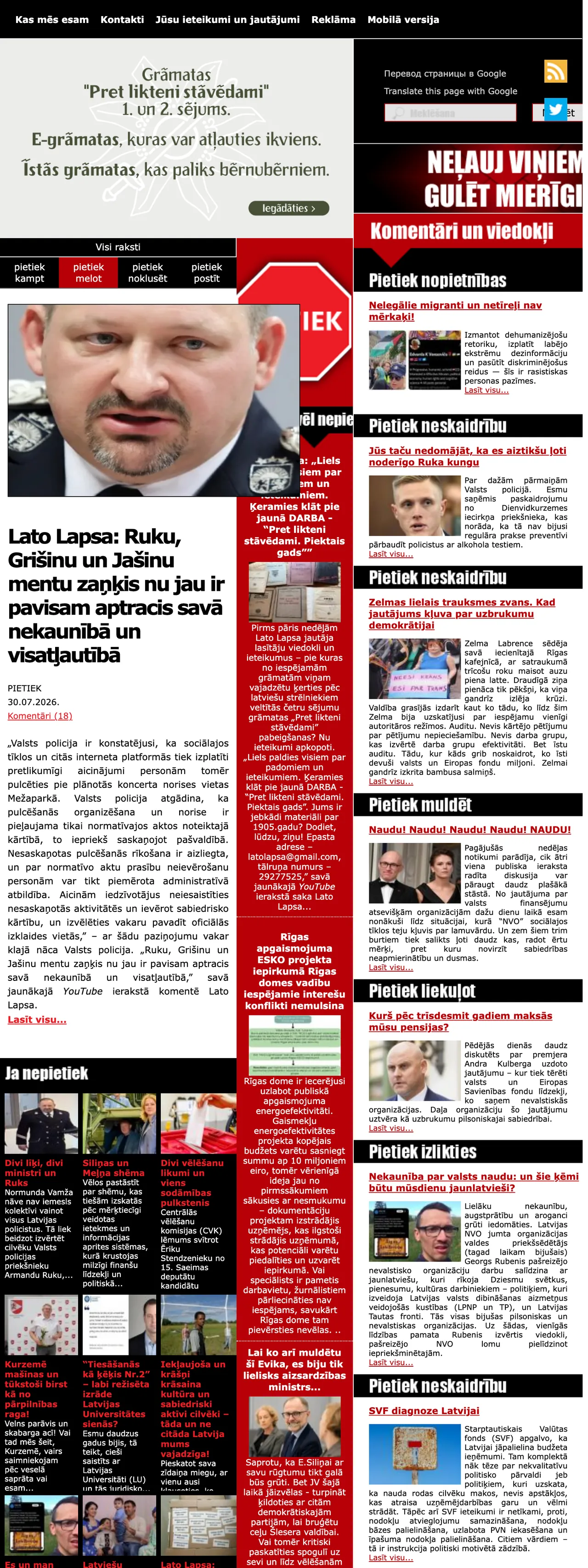
This article by Lato Lapsa criticizes the actions and perceived lawlessness of certain officials, particularly mentioning Ruku, Grišinu, and Jašinu, and references a police statement about illegal calls for public gatherings.
This story suggests that the death of Normunds Vamžs should not lead to blaming all Latvian police officers, and calls for an evaluation of the State Police chief, Armands Ruks.
The article alleges a scheme involving significant financial resources and political influence, potentially related to Siliņa and Melnis.
The Central Election Commission's decision to remove Eriks Stendzenieks from the candidate list for the 15th Saeima is discussed, indicating issues with election laws and eligibility.
This article expresses a sense of disbelief or concern about the distribution of wealth or resources, specifically mentioning cars and money in the Kurzeme region.
The author, with long-standing ties to the University of Latvia, questions a legal situation that is described as a 'well-directed play'.
This piece advocates for an inclusive and vibrant culture with active citizens, suggesting this is the desired future for Latvia.
This article defines a group of people as the core of civil society and the foundation of modern Latvia, emphasizing their importance.
The first part of a series discussing what is presented as the 'only hope' for the Latvian people, starting with the topic of colonization.
Lato Lapsa raises concerns about the integrity of election results, shifting the focus from the possibility of theft to the methods that might be used.
A legal professional discusses instances where law enforcement agencies, specifically the State Police, are perceived to overstep their authority and disregard individual fundamental rights.
The article addresses the public sale of a container for a '9M111M anti-tank missile' in Latvia, noting that it's advertised as legal and questioning the implications for equal treatment.
This article discusses the use of dehumanizing rhetoric and disinformation by extremists, potentially linking it to issues with migrants.
The article focuses on Zelma Labrence's observations about a discussion that she perceives as undermining democracy, possibly related to state audits and financial matters.
This story appears to be a commentary on public discourse and discussions, possibly related to social or financial issues impacting ordinary people.
This article questions the sustainability and funding of pensions in Latvia, exploring the financial challenges after three decades.
This piece criticizes the behavior of certain individuals or groups regarding state finances, questioning their suitability as modern Latvians.
The article discusses the International Monetary Fund's (IMF) assessment of Latvia, suggesting it involves a 'stop sign' and touches upon issues of political will and financial accountability.

 Latvia