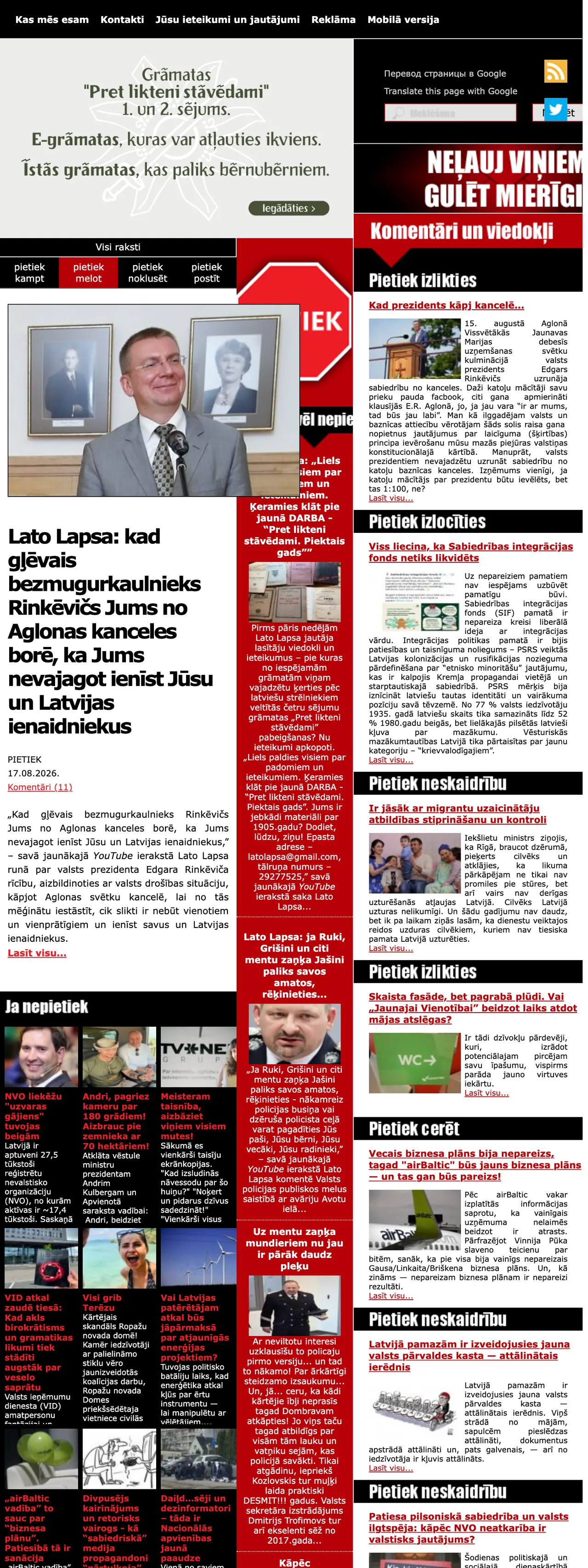
Front page lead
Lato Lapsa criticizes President Edgars Rinkēvičs's sermon from Aglona, arguing that the president's call for unity against enemies is hypocritical given the current security situation and the need for national resolve.
The article discusses the declining influence and activity of non-governmental organizations (NGOs) in Latvia, noting a significant number of registered but inactive organizations and questioning their societal impact.
An open letter to Prime Minister Andris Kulbergs and the 'United List' leadership, urging them to focus on the plight of farmers with 70 hectares instead of promoting misleading agricultural policies.
This piece appears to be a commentary on extreme public reactions and calls for severe punishment, possibly related to a crime or societal issue, with the author citing online comments.
The article reports that the State Revenue Service (VID) has lost another court case, highlighting issues of bureaucratic inefficiency and the rigid application of rules over practical judgment.
A scandal in the Ropaži municipality council is detailed, focusing on the actions of the deputy chairwoman responsible for civil defense and security amidst public scrutiny of the new coalition.
The article discusses the upcoming political debates surrounding energy policy, suggesting that renewable energy projects might lead to increased costs for consumers, serving as a tool for political manipulation.
The article criticizes the management of the national airline airBaltic, stating that their 'business plan' is a disguised restructuring aimed at writing off debts, raising concerns about its financial viability.
This piece questions the reporting of Latvia's public media regarding a letter from MEP Roberts Dombravas to Spanish officials, suggesting a biased or propagandistic interpretation.
The article criticizes a new generation within the National Alliance party, labeling them as 'artful dodgers' and 'disinformation agents', specifically mentioning individuals associated with the 'Latvia for Latvians' account.
A personal reflection from someone working within the internal affairs system since 2008, discussing their evolving role and the changes within the institution up to April 2024.
The article criticizes the career path and secretive methods of Jēkabs Straume, the head of the Corruption Prevention and Combating Bureau (KNAB).
The article questions the activities and budget of the State Chancellery's Innovation Laboratory, suggesting that its work, described as 'sprints' and 'prototyping', may be inefficient or unproductive.
This article seems to be an opinion piece or commentary on the state of public morality and values in Latvia, potentially linked to recent events or societal trends.
A critical look at NGOs in Latvia, suggesting their 'parasitic' nature and diminishing influence, with a focus on those that are registered but inactive.
This is a continuation or related piece to the top story, featuring Lato Lapsa's commentary on President Rinkēvičs's speech in Aglona and its interpretation by the public media.
This article details a court ruling against the State Revenue Service (VID), criticizing its officials for excessive bureaucracy and prioritizing rigid rules over practical solutions.
This piece examines the potential financial burden on consumers due to renewable energy projects, framing it as a recurring issue influenced by political maneuvering.
The article exposes 'airBaltic management's' 'business plan' as a deceptive restructuring effort aimed at debt write-offs, raising concerns about the airline's financial health.
This article criticizes the Latvian public media's coverage of an MEP's letter to Spain, alleging a propagandistic interpretation and questioning their journalistic integrity.
The article identifies a new generation within the National Alliance party as 'artful dodgers' and 'disinformation agents,' pointing to specific individuals associated with the 'Latvia for Latvians' X.com account.
A personal account from an insider reflects on the institutional changes within a law enforcement agency from 2008 to April 2024, questioning the current direction of Latvia.
This article critically examines the career trajectory of Jēkabs Straume, the head of Latvia's Corruption Prevention and Combating Bureau (KNAB), alleging a pattern of secrecy and self-preservation.
The article questions the productivity and necessity of the State Chancellery's Innovation Laboratory, highlighting its 'sprints' and 'prototyping lab' as potentially wasteful activities.
The article questions the effectiveness of 'uniting' and criticizes the superficiality of certain public figures or initiatives, suggesting a lack of substance behind the outward appearance.
This article reiterates criticism of airBaltic's financial strategies, stating that the new 'business plan' is just as flawed as the previous one, and will likely lead to further financial issues.
The article argues that Latvia is creating a system that benefits a select group, necessitating an 'attestation' or review process to ensure fairness and accountability within the system.
This is a rhetorical question suggesting a focus on corruption within the public sector, likely leading into an analysis or investigation of such issues.
The article discusses how to actively involve non-governmental organizations (NGOs) in discussions about Value Added Tax (VAT) and other tax-related issues to foster a more engaged and proactive civil society.

 Latvia