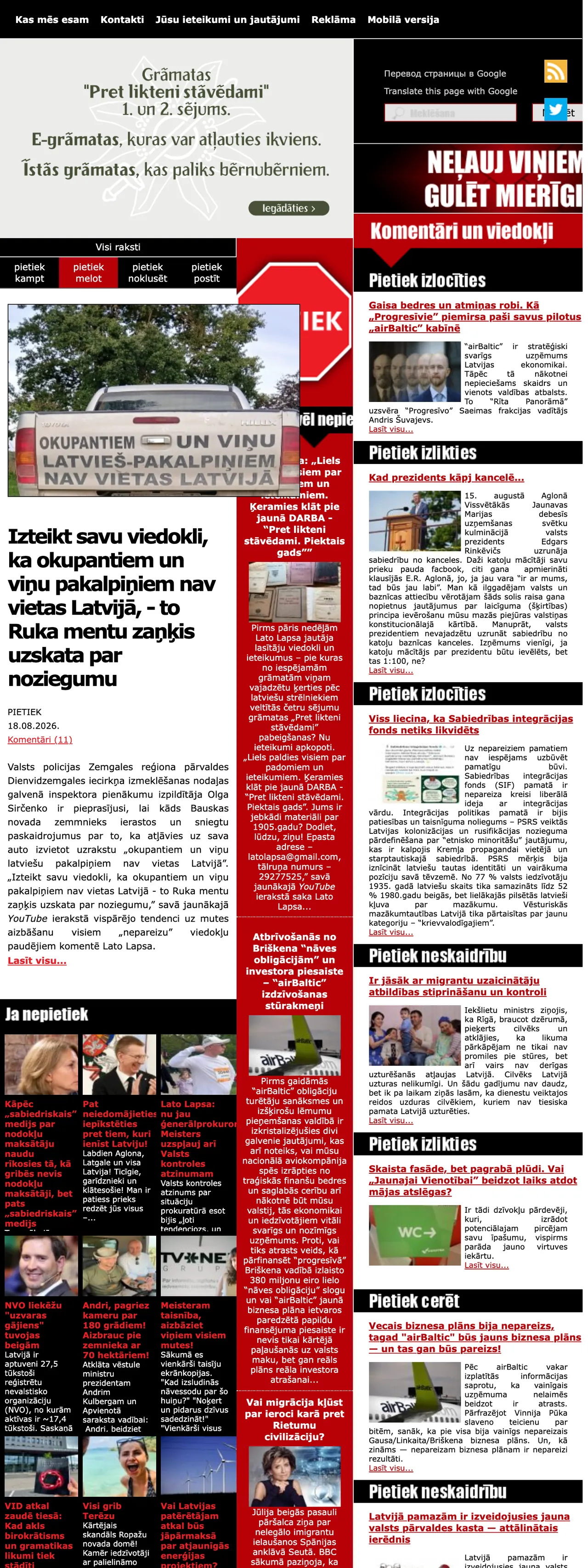
Front page lead
A farmer in Bauska municipality is being investigated for displaying a slogan on his car that reads 'Occupiers and their Latvian lackeys have no place in Latvia.' The article criticizes this as an attempt to silence dissent, referencing Lato Lapsa's commentary.
This article questions the autonomy and spending decisions of Latvia's public media (LSM), suggesting they act according to their own desires rather than the will of the taxpayers.
This piece appears to be a commentary or speech, possibly religious in nature, addressing attendees in Aglona, Latgale, and all of Latvia, with themes of faith and patriotism.
The article reports that Prosecutor General Meisters has criticized a State Audit Office report on the prosecutor's office as 'very tendentious' and 'superficial.'
This story discusses the large number of registered NGOs in Latvia (around 27,500 active) and suggests their influence or 'victory march' may be concluding.
An open letter addressed to Prime Minister Andris Kulbergs and the United List leadership, urging them to pay attention to the concerns of small farmers rather than focus on promotional activities.
This article seems to be a reaction to or commentary on the statements made by Prosecutor General Meisters, possibly in response to controversial opinions or actions.
The State Revenue Service (VID) has lost a court case, with the article criticizing the institution for prioritizing bureaucratic procedures and strict interpretations of rules over common sense.
A scandal in the Ropaži municipality council is discussed, focusing on the work of the deputy chairperson of the Ropaži Municipal Council regarding civil defense and security.
This article predicts that renewable energy projects will become a political tool for manipulating voters as elections approach, potentially leading to higher costs for consumers.
The article questions the financial strategy of airBaltic, suggesting that what management labels a 'business plan' is actually a restructuring or bailout due to financial difficulties.
This article criticizes the Latvian public media for its interpretation and reporting on a letter sent by an official (likely referring to an MEP or government representative) to Spain.
This story delves into the financial dealings and political connections surrounding the 'Progressives' and their alleged influence on personnel appointments within the airline airBaltic.
The article discusses the current president's entry into the chancellery and provides commentary on political events and figures in Latvia, including references to officials like Meisters and the State Audit Office.
This article alleges 'dirty politics' within the public media concerning integration funds and criticizes how these funds are managed, linking them to Latvian political parties and historical narratives.
This piece examines the financial situation of airBaltic, questioning the guarantees provided by investors and suggesting that the airline's obligations remain a significant financial burden.
The article discusses the issue of migration and the need for regulation and control, mentioning the process of examining individuals arriving in Latvia and the procedures for their stay.
This article revisits the reporting of the Latvian public media on a letter sent by an official to Spain, questioning the media's interpretation and framing of the event.
The article explores the potential threats posed by migration to Western civilization, discussing concerns about cultural and societal changes.
This article provides a critical assessment of the newly formed Latvian government, deeming it 'inadequate' and likely to struggle with its responsibilities.

 Latvia