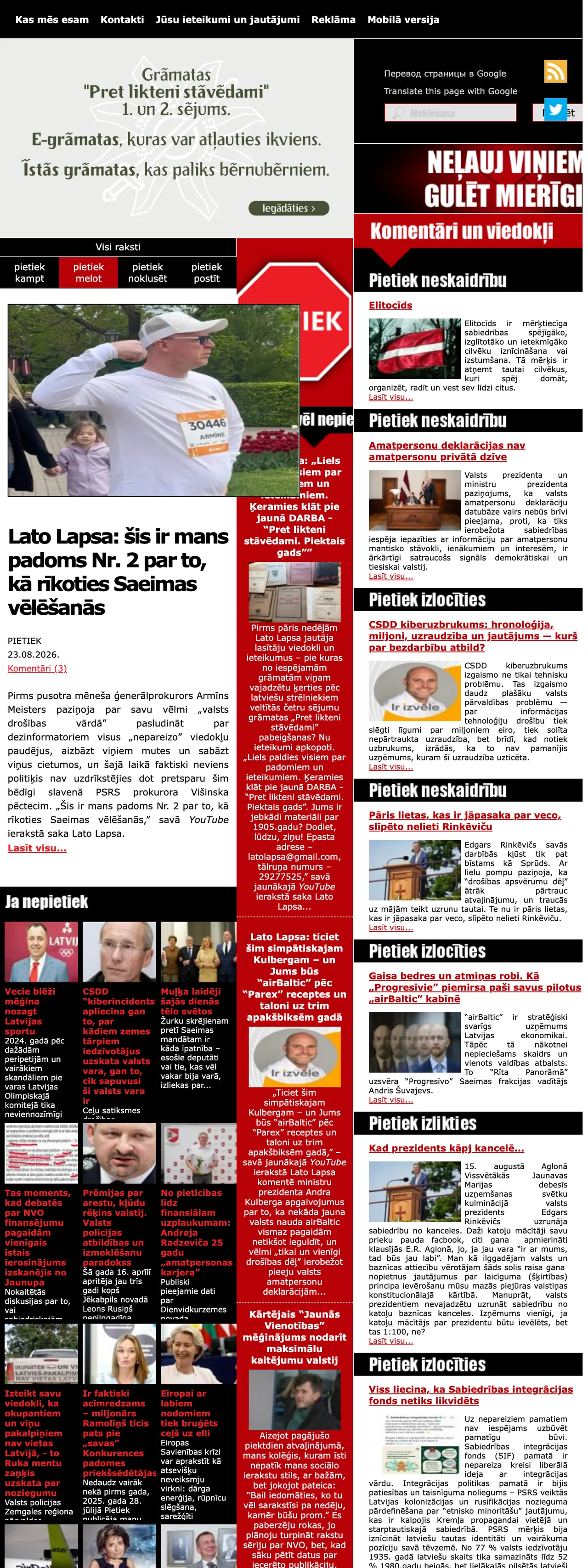
Front page lead
Political commentator Lato Lapsa provides his second piece of advice on how to approach the parliamentary elections, criticizing the Prosecutor General's stance against dissenting voices and urging opposition to perceived authoritarian measures.
The article discusses controversies and scandals surrounding the leadership of the Latvian Olympic Committee, hinting at potential corruption and questionable practices in Latvian sports management.
A cyber incident at the Road Traffic Safety Directorate (CSDD) is used to highlight what the author perceives as the Latvian state's disregard for its citizens and the overall corruption within the government.
This article appears to critique politicians or public figures who, despite past actions or positions, are now presenting themselves as virtuous or righteous, particularly in the context of parliamentary elections.
The article focuses on a debate regarding the funding of non-governmental organizations (NGOs), suggesting that a proposal by Jaunups was the only substantial contribution to the discussion.
This story likely investigates a case involving the State Police, focusing on apparent paradoxes in accountability and the financial consequences for the state stemming from police actions or errors.
The article examines the financial status and career progression of Andrejs Radzevičs, a deputy chairman of the Dienvidkurzeme municipal council, based on publicly available data.
This story reports on an incident where expressing an anti-occupation or anti-collaboration sentiment is allegedly being treated as a crime by law enforcement, specifically mentioning the Southern Kurzeme precinct of the State Police.
The article alleges that millionaire Ramoliņš has influenced the appointment of the chairwoman of the Competition Council, suggesting a conflict of interest or undue influence.
This article offers a critical perspective on the European Union, describing its current crisis characterized by high energy costs, factory closures, and burdensome regulations, suggesting a flawed path for the bloc.
The article discusses the financial strategies and challenges facing the Latvian airline airBaltic, focusing on the need to escape certain financial obligations and secure new investors for its survival.
This piece explores the complex issue of migration, framing it as a potential weapon in a broader conflict against Western civilization, referencing an incident in the Spanish enclave of Ceuta.
This article appears to be an analysis or commentary on the Latvian elite, their actions, and their perceived influence within the country, possibly touching upon issues of governance and societal structure.
The article delves into the declarations of assets of public officials, scrutinizing their wealth and private lives, and the potential implications for transparency and accountability in governance.
This article revisits the CSDD cyber incident, detailing its timeline, the financial implications, and the ongoing investigation, questioning who bears responsibility for the failures.
This piece criticizes Foreign Minister Edgars Rinkēvičs for allegedly dismissing or downplaying past issues or historical matters, suggesting a lack of engagement with significant events.
The article suggests that 'progressives' within airBaltic have betrayed their pilots, implying internal conflict or mismanagement within the airline's leadership.
This article likely discusses the early days of a Latvian president in office, potentially touching upon initial challenges, policies, or public perceptions of their tenure.
This article criticizes the integration funds in Latvia, suggesting that the primary goal has become ensuring the money is not spent, rather than achieving actual integration outcomes.

 Latvia