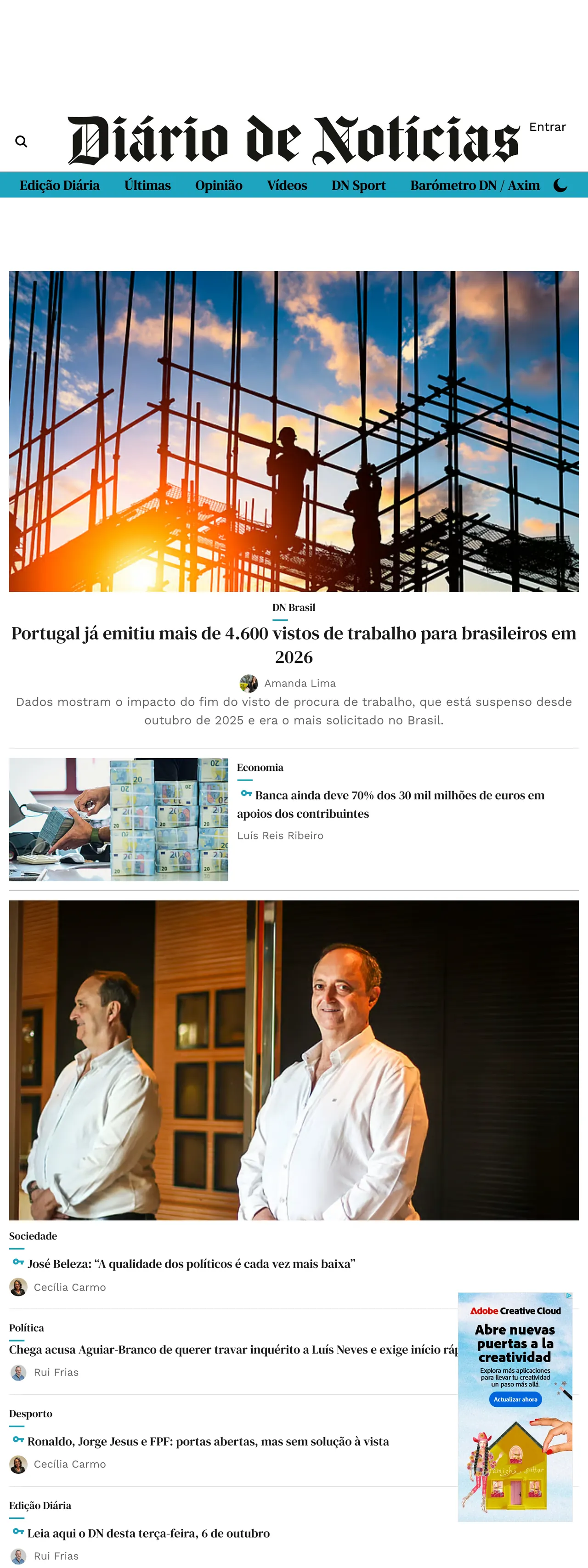
Front page lead
Portugal has issued more than 4,600 work visas for Brazilians in 2026, reflecting the impact of the end of the work-seeking visa, which was suspended in October 2025 and was the most requested visa type in Brazil.
Banks have yet to repay 70% of the 30 billion euros in financial aid received from taxpayers.
José Beleza comments that the quality of politicians in office is declining.
The Chega party accuses Aguiar-Branco of attempting to hinder an investigation into Luís Neves and demands a swift start to the parliamentary inquiry commission (CPI).
Discussions involving Ronaldo, Jorge Jesus, and the Portuguese Football Federation (FPF) are ongoing with open communication, but a resolution remains elusive.
A summary or highlight of the articles featured in Tuesday's edition of Diário de Notícias, dated October 6th.
In the Brazilian elections, Tarcísio de Freitas is elected vice-governor of São Paulo, Sergio Moro wins his race, and Ciro Gomes is defeated.
Flávio Bolsonaro is positioned favorably for the second round of elections due to favorable statistics, current circumstances, and historical precedents.
The deep political divisions within Brazil are negatively impacting its ability to assert itself and gain international influence and power.
The wife, two sons, and one brother of former President Jair Bolsonaro have been elected to office.
Lula da Silva acknowledges an unexpected outcome in the election, while Flávio Bolsonaro suggests that the Workers' Party (PT) era is concluding.
According to Datafolha, Flávio Bolsonaro holds an initial advantage going into the runoff election.
The Brazilian expatriate voting process in Lisbon was calm but saw low turnout.
In the expatriate vote in Portugal, Lula da Silva secured victories in Porto and Lisbon, while Jair Bolsonaro won in Faro.

 Portugal