Front page lead
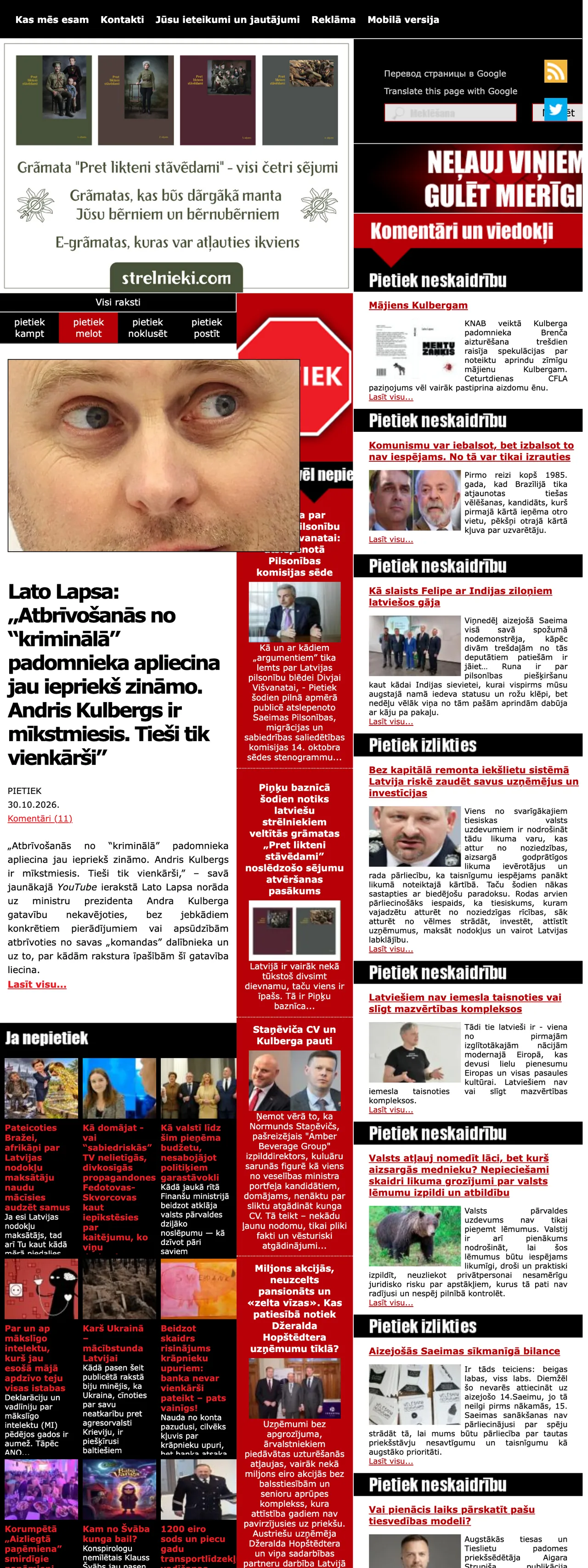
Journalist Lato Lapsa suggests that Prime Minister Andris Kulbergs's swift dismissal of an advisor, without concrete evidence, reveals his character weakness. Lapsa pointed out this behavior in a recent YouTube post.
Latvian taxpayers' money will fund a catfish farming initiative in Africa, attributed to the efforts of Braže. The article implies a questionable allocation of public funds for international development.
The article questions whether a specific propagandist from 'public' television will address the harm caused to a minor who was a victim of sexual harassment, linking it to her workplace.
The article delves into the historical methods by which the state budget has been approved in Latvia, suggesting a pattern of circumventing political discontent to pass financial legislation.
The proliferation of declarations and guidelines on Artificial Intelligence (AI) is noted, indicating its increasing integration into various aspects of life and society.
The ongoing conflict in Ukraine, where the country fights for its independence against Russia, is presented as providing an advantage to the Baltic states.
A solution is presented for victims of financial fraud, addressing situations where banks refuse reimbursements by claiming the victim was at fault.
The article criticizes the show 'Aizliegtais paņēmiens' (Forbidden Move) for alleged unethical and illegal broadcasting practices, specifically mentioning an interview with a drunk driver.
The article discusses the enduring relevance of Klaus Schwab's concepts, despite his perceived removal from public discourse by conspiracy theorists.
A state police decision imposing a 1200 euro fine and a five-year driving ban is detailed, noting the officer's failure to identify himself and the withholding of video evidence.
The Saeima (Latvian Parliament) granted citizenship to Indian businessman Kanans Vishvanathan through a special law passed in a single session, without any opposing votes.
The author feels compelled to inform the public and media about the reasons behind a situation, suggesting a conspiracy involving individuals and the e-signature system.
The latest Programme for International Student Assessment (PISA) study results are presented, which are organized by the Organisation for Economic Co-operation and Development (OECD).
An article mentions the dismissal of Kulbergs' advisor due to allegations, with a sidebar discussing his character.
The article discusses the debatable nature of communism and suggests that it cannot simply be abandoned, implying a need for reflection rather than immediate dismissal.
The article describes how Felipe of Brazil's actions mirrored those of a Latvian senator, suggesting a connection in their political approaches or situations.
Latvia faces the risk of losing uninvested funds due to a lack of capital for renovating its interior systems, indicating potential financial mismanagement or underfunding.
The article presents the curriculum vitae of Normunds Stanēvičs, who is involved in a scandal concerning Amber Beverage Group, and his potential candidacy for minister.
The text briefly mentions Latvia's diverse tourist attractions, ranging from its capital city to Pinku street, indicating a focus on local travel and landmarks.
The article argues that Latvians should not feel inferior about their regional dialects, emphasizing that these are part of modern European and Latvian cultural heritage.
The state is ordered to pay compensation for damages, with the article stating that inconsiderate individuals are not beneficial to the state.
Millions of euros are involved in illicit activities and corrupt management within pension funds, with implications for investment and public trust in Austria and Latvia.
Businesses are operating without accountability, individuals are involved in bribery, and illegal investments are occurring, affecting economic stability and public perception.
The article discusses a problematic balance within the Seimas (parliament), suggesting that the government is at risk of losing its investors due to current policies or actions.
The article poses a question about the timeliness of re-evaluating existing assumptions and beliefs, suggesting a need for critical self-reflection.

 Latvia