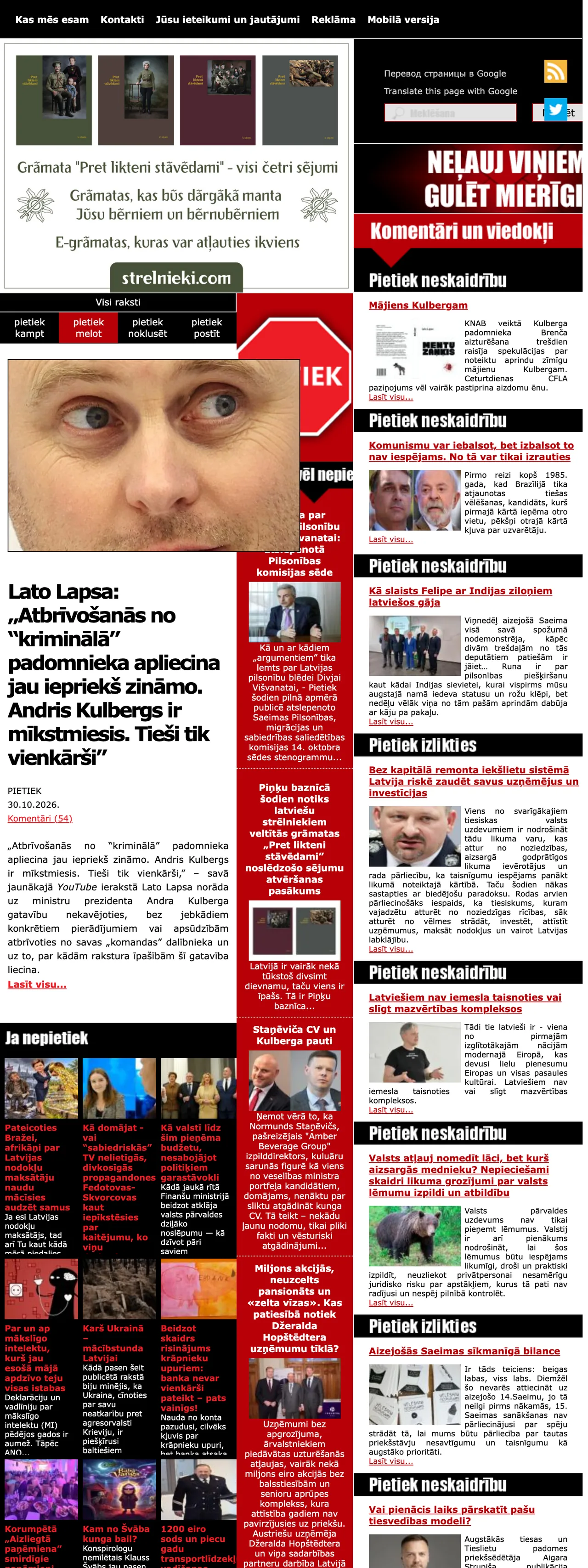
Front page lead
Author Lato Lapsa criticizes Prime Minister Andris Kulbergs for immediately dismissing an advisor without concrete evidence, interpreting this as a sign of weakness and character flaws.
Latvian taxpayer money is being used to fund training for Africans in catfish farming, a program highlighted by the article.
The article questions whether a public television propagandist will acknowledge the harm caused by their workplace to a minor who was a victim of sexual assault.
The article delves into the historical methods by which Latvia has managed to pass state budgets without causing significant political dissatisfaction.
The piece discusses the proliferation of artificial intelligence declarations and guidelines in recent years, noting its increasing presence.
The article reflects on the war in Ukraine, suggesting that Ukraine's fight for independence against Russia has given the Baltic states an advantage.
This article addresses the issue of bank customers becoming victims of fraud, where banks often refuse refunds by stating the victim is at fault.
The article criticizes the TV show 'Aizliegtais paņēmiens' (Forbidden Move) for broadcasting an interview with a drunk driver, allegedly against professional ethics and legality.
The article discusses the enduring relevance of Klaus Schwab's concepts, despite him being sidelined by conspiracy theorists.
A state police decision imposing a 1200 euro fine and a five-year driving ban is contested because the officer did not identify himself and a video recording was withheld.
The Saeima (Parliament) granted citizenship to Indian businessman Kanana Vishvanathan through a special law in a single session, bypassing normal procedures.
The author explains why they feel the need to inform the public and media about issues related to e-signatures and potential conspiracies against them.
The latest Programme for International Student Assessment (PISA) study's results are presented, with the article suggesting a lack of optimism regarding Latvian education.
The article discusses how Latvia has historically managed to pass its budgets without causing significant political dissatisfaction.
The article investigates how Dzheralda Hopstedter's companies, which have received millions in investments, are being managed and whether pension funds are being utilized effectively.
The article suggests that companies operating without proper approval are awaiting sanctions, and legal proceedings are underway for involved parties.
The article points out that Latvia's interior system is at risk due to a lack of investment in repairs, despite potential benefits from other investments.
The article expresses concern over the Saeima's fiscal balance, suggesting that upcoming budget proposals might not be in the best interest of the public.
The article argues that Latvians have no grounds for feelings of superiority, citing historical and cultural contexts.
The article discusses criminal negligence by state officials, arguing that they should not be excused for causing irreparable harm to the public interest.

 Latvia